
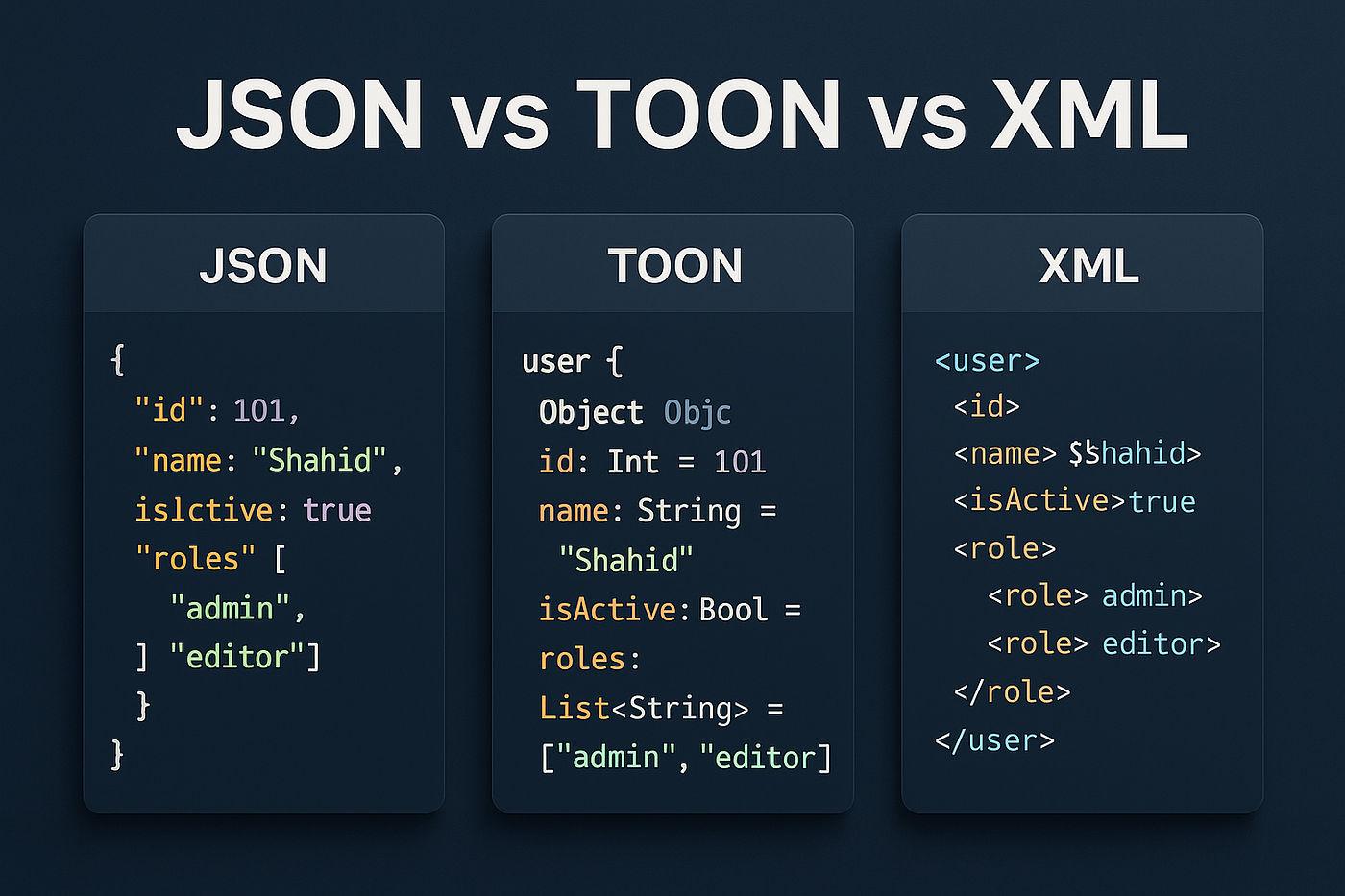
In the world of data interchange, JSON (JavaScript Object Notation) has been the undisputed standard for decades. It's simple, human-readable, widely supported across languages, and powers everything from APIs to configuration files. But as Large Language Models (LLMs) and generative AI become central to modern applications, a new format is gaining traction:
TOON (Token-Oriented Object Notation).
TOON isn't here to completely replace JSON—it's optimized specifically for scenarios where data is fed into token-based AI models. In this blog post, we'll compare the two formats, explore their strengths and weaknesses, and help you decide when to use each.
What is JSON?
JSON is a lightweight, text-based format for representing structured data using key-value pairs, objects (curly braces {}), arrays (square brackets []), and primitive types like strings, numbers, booleans, and null.
Example of JSON:
[
  {
    "id": 1,
    "name": "John",
    "role": "Developer",
    "active": true
  },
  {
    "id": 2,
    "name": "Sara",
    "role": "Designer",
    "active": false
  }
]
JSON's verbosity comes from repeated keys, quotes around strings, colons, commas, and structural punctuation. While perfect for web APIs and general programming, this adds up in LLM prompts, where every token counts toward cost and context limits.
What is TOON?
TOON (Token-Oriented Object Notation) is a newer, open-source format designed explicitly for LLM efficiency. It preserves the same data model as JSON (objects, arrays, primitives) but removes redundant syntax like repeated keys, quotes (for simple cases), braces, and commas in tabular structures.
TOON uses indentation, header rows, and compact notation—similar to a blend of CSV and YAML but structured for AI consumption.
Example of the same data in TOON:
users{id,name,role,active}:
1,John,Developer,true
2,Sara,Designer,falseJSON vs TOON: Key Differences at a Glance
- Token Efficiency
JSON carries heavy syntax overhead (quotes, braces, repeated keys).
TOON cuts 30–60% of tokens (often ~40–50% in real benchmarks), directly lowering costs and freeing context window space. - Readability & Familiarity
JSON is instantly familiar to developers and supported by every editor/tool.
TOON feels more tabular and concise — very readable for flat/structured data, but less conventional for deeply nested structures. - Best Data Shapes
JSON handles arbitrary nesting, irregular objects, and complex hierarchies effortlessly.
TOON excels with uniform arrays of objects (tabular data); nesting is supported but less compact. - Ecosystem & Tooling
JSON wins with mature parsers, validators, schemas, and universal adoption.
TOON is newer — converters exist (e.g., official TypeScript/Python SDKs on GitHub), but tooling is still growing. - LLM Performance
Benchmarks show TOON often delivers higher accuracy (e.g., +4–13% in structured extraction tasks) because models face less irrelevant syntax. - Primary Use Case
JSON → APIs, configs, general data exchange, public-facing systems.
TOON → LLM prompts, RAG pipelines, agent tool calls, structured outputs, cost-sensitive AI features.
Benchmarks from sources like DigitalOcean, Reddit discussions, and independent tests show TOON delivering 40–80% token savings in many real-world LLM reasoning tasks, with improved performance in structured data extraction.
When Should You Use JSON?
- Building REST APIs or microservices
- Storing configuration files
- Exchanging data between non-AI systems
- Needing maximum compatibility and tooling
- Working with deeply nested or irregularly shaped data
JSON remains the gold standard for general-purpose structured data.
When Should You Use TOON?
- Feeding structured data (e.g., database rows, logs, metadata) into LLM prompts
- Optimizing costs in high-volume AI applications (RAG, agents, fine-tuning examples)
- Reducing context window pressure for longer reasoning chains
- Improving model accuracy on tabular or repetitive structured inputs
TOON shines in GenAI workflows where token costs directly impact your bottom line.
Real-World Impact
Imagine including a 500-row customer dataset in an LLM prompt for analysis:
- JSON version: ~Higher token count → increased API costs and potential truncation
- TOON version: 40–60% fewer tokens → lower bills, more room for instructions, and often better results
Many developers report switching to TOON for prompt engineering and seeing immediate savings without losing data fidelity.
Conclusion: Not a Replacement, But a Specialized Upgrade
JSON isn't going anywhere—it's too entrenched and versatile. TOON doesn't aim to kill JSON; it solves a very specific 2025+ problem: making structured data cheaper and more effective for AI models.
The future of data formats in AI is about optimization for the reader—and right now, that reader is increasingly an LLM.
What are your thoughts? Have you tried TOON in your projects? Share in the comments below!
Sync Scrum – Empowering Smarter AI Solutions